The Paper List, Kept All Week
Your phone has a notes app, and the notes app is perfectly fine. Yet in most houses the list that really gets used is still a strip of paper under a magnet, and the reasons are worth a closer look if you would like your head to stay quick through the years still ahead of you.
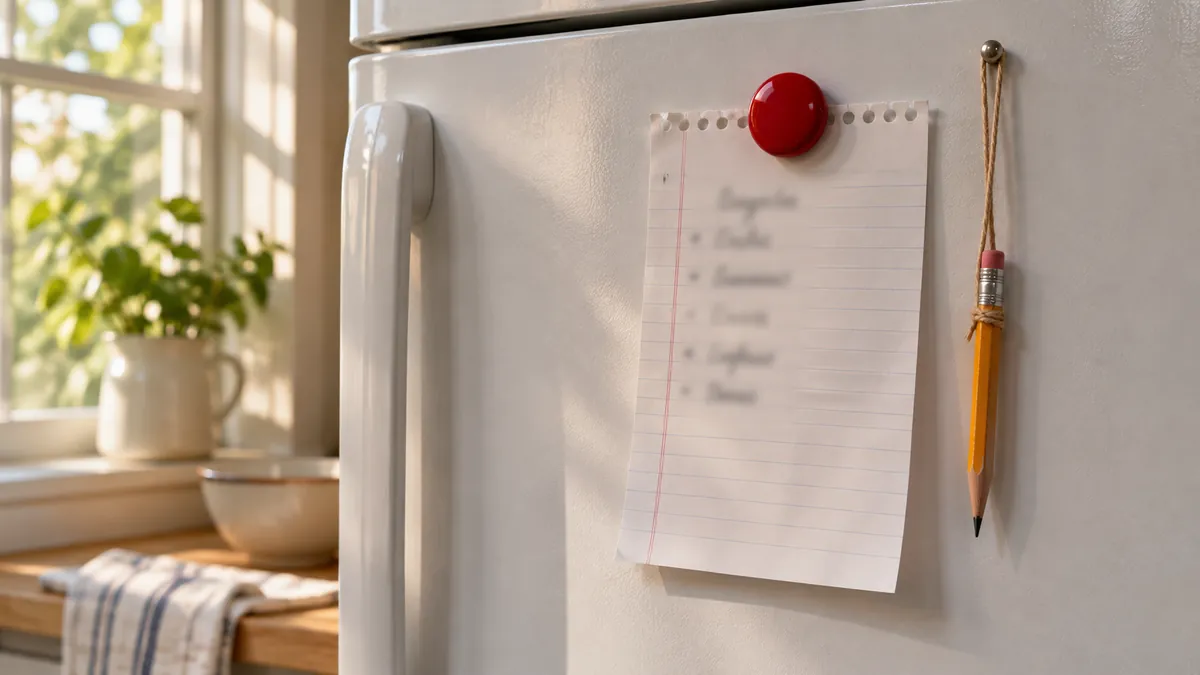
Writing it at the moment it happens
The list only works when it is written the moment the need shows up. The last spoonful of coffee, the final roll of paper towel, the dish soap that sputters instead of pouring: that is when the pencil should move. Waiting until Saturday morning to sit down and make the list turns a recording job into a recall job, and pulling a whole week back out of your head in one sitting is about the hardest version of remembering most of us ever attempt.
There is a second reason to use the pencil. Writing by hand is slower than tapping a screen, and that slowness pays. To write the word rice you shape four letters, and somewhere in that small effort the item settles a little more firmly than it would if you had spoken it to a gadget on the counter. People who study note-taking have compared hand writers with typists, and the hand writers frequently recall the material somewhat better later on, even when they wrote down less of it. You hardly need a study to test it at home. Write the next three things you run out of, then see on Thursday how many you can name without peeking.
Keep the paper where the need gets noticed. In most homes that means the refrigerator, which is opened twenty times a day and stands next to most of the things that run out. A list kept in a drawer is a list nobody adds to.
Saying it back before you look
This is the part that turns a chore into practice. Before leaving the house, stand at the refrigerator with your back to the paper and say the list out loud. Perhaps not all of it; whatever surfaces. Then turn around and compare.
For the first few weeks the score may feel humbling, and that is fine, because the attempt itself is the exercise. Fetching an item back out of memory, instead of simply reading it again, is what memory researchers call retrieval practice, and it ranks among the better studied ways of helping information stay put. Each time you reach for eggs, lemons and batteries and come back with two of the three, the route to those words gets a little more worn in.
Grouping makes the load lighter. Things for breakfast. Things that live under the sink. Things that have to come from the hardware counter instead. Three small bundles are far easier to hold than nine loose words, and the bundling habit spreads into the rest of the day: the three calls to return, the three bills to look over, the three things to carry out to the car.
Once a week, try the entire list from memory inside the shop, before the paper leaves your pocket. Walk the floor, fill the basket from what you recall, and only then unfold the sheet for whatever slipped past. It costs perhaps two minutes and makes the trip feel less like an errand and more like a game you are slowly getting better at.
Crossing it off, and what the lines tell you
Back home, lay the paper on the counter and draw a line through everything that made it into the bags. There is a small and honest satisfaction in that. There is also information in it. If stamps has survived three weeks without a line through it, the trouble is not your recall; the errand simply belongs somewhere else, at the post office on Tuesday or on another list altogether.
A crossed-off list doubles as a modest diary. Read through last month's sheets and you can reconstruct a surprising amount: the week a grandchild came to stay, the week of the head cold, the week someone in the house decided to start baking bread again. Looking back over your own record of plain days is a gentle way to keep dates and the order of things straight, and it asks nothing beyond keeping the paper.
A few rules for the paper
- One list, one place. Two lists in two rooms turn into no list at all by Friday.
- A pencil that lives with the paper. If finding a pen takes longer than remembering the item, the item will not get written.
- Plain words. Coffee is better than a brand name you will have to decode in the shop.
- Room for everyone else in the house. A list only one person writes becomes that person's job; a list the whole household writes becomes a memory you share.
- A fresh sheet each week. The old one goes into a drawer, which is the subject of one of the shorter notes.